
Case Studies
Have You Considered
Exit Strategy Options?
In Advanced economies, family-run companies are the foundation of their national economy, accounting for around 70% of all businesses and employing half of the national workforce.
Article Contributor: D-K
At a Glance – Being a Business Owner in Leading Economies
In an advanced economy, family-run companies are the foundation of the national economy, accounting for around 70% of all businesses and employing half of the national workforce, according to a leading consulting firm’s Family Business Survey 2023. These companies embody family legacy, the expansion of the economy, and the entrepreneurial spirit woven together.
But at some point, in these companies’ and entrepreneurs’ life cycles, thinking about an exit strategy becomes imperative. An effective exit strategy is more than just giving up ownership or control; it’s about ensuring the company’s principles endure and remain economically viable in a way that supports the family’s objectives and culture.
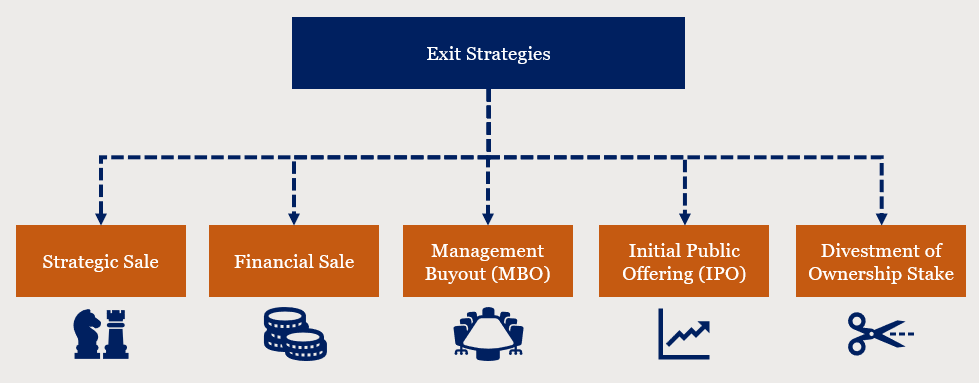
The World of Business Exit Strategies
While navigating the exit process can appear complex and intimidating, this piece will hopefully shed light on what’s available and provide enough insight to further the conversation.
This article critically analyses the various exit strategies available to family-owned businesses, each with its unique processes, implications, and outcomes. While at face value, there is no clear best exit strategy, and all the above-mentioned exit plan strategies require a broad range of differing considerations – most of the specific exit strategy points are fluid. They should be evaluated through a holistic business exit planning lensStrategic Sale
Introduction
The first successful exit strategy we will investigate is a strategic sale, which can be attractive. A strategic sale involves selling a business to a buyer who sees a specific strategic fit and value in acquiring it. In most cases, these buyers will often be looking to achieve the following strategic goals:
- Expand their market reach
- Acquire new capabilities
- Gain competitive advantages.
A strategic sale emphasizes the core M&A principle of 1+1=3, such as synergies between the acquiring and acquired companies. The buyer in a strategic sale is typically a company operating in the same or a related industry. These buyers exhibit a clear interest in various aspects of the target:
- Unique assets
- Customer base
- Intellectual property
- Market position
This approach often aims to preserve the core values and operational ethos of the business in conjunction with leveraging the established resources and networks of the acquiring entity to facilitate growth/diversification.
The Process
The process of a strategic sale typically involves three critical steps:
- Identifying potential buyers
- Valuing the business
- Negotiating the terms of the sale
In the first step, identifying the right buyer is usually paramount for a strategic sale. Achievement of this step requires a deep understanding of the market. During this stage, prospective buyers must share a similar vision/can bring added value to the business while ensuring that the legacy and ethos of the family business are respected.
Second, accurately valuing the business becomes crucial once potential buyers are identified. This valuation encompasses not just the financial aspects but also intangible assets like brand value and customer loyalty. Often, with long-standing family businesses, the latter poses the most intriguing value proposition and should be determined through extensive analysis.
The final step pertains to negotiating terms. This process consists of a delicate balance between achieving the desired financial outcome and ensuring that the strategic objectives of the sale are met. Negotiating terms can be a complex and intimidating process. Business owners must ensure during this stage that deal terms are adequately examined and deliberated alongside industry professionals such as financial advisors or lawyers.
Takeaway
Thus, a strategic sale offers a unique opportunity to pass on the reins while preserving the intrinsic values and ethos of the business, focusing on finding a buyer whose vision and objectives align with the original company’s legacy.
Financial Sale

Overview
In the next step, we will look into common exit strategies that have various similarities to the previous exit strategy, albeit critical core differences.
In family businesses, a financial sale refers to the process where the primary motive is financial gain. Usually, transactions of this nature involve the sale of the company to parties such as private equity firms or venture capitalists.
This type of sale is particularly suitable for family businesses looking to sell out for a substantial financial return, especially when there is no clear succession plan or the current owners wish to exit the business entirely.
Private equity firms and venture capitalists find such businesses attractive investments due to their ability to inject capital to nurture increases in growth, profitability, and implementation of operational efficiencies.
However, one of the most important distinctions to recognise compared to strategic sales is that financial sales are less focused on maintaining the legacy or ethos of the family business. Rather, financial returns are prioritised as the paramount strategic concern pre and post-acquisition.
Execution/Key Factors
Preparing a family business for a financial sale is a critical process that enhances its attractiveness to potential buyers, primarily focusing on its financial health and operational efficiency.
This preparation often includes streamlining operations, optimising the financial structure, and ensuring all legal and regulatory compliances are in place. The points above are universal – key considerations that should be implemented across all types of exit strategies. Similarly, the critical aspects of a financial sale transaction process are largely interchangeable with a strategic sale.
Summary
In summary, while financial sales offer substantial monetary gains for family businesses, they often come with transformative changes in operational structure and management, marking a significant shift from the original ethos and legacy of the family-owned enterprise.
Initial Public Offering (IPO)

Overview
An Initial Public Offering differs from the previously discussed exit strategies mainly due to its key difference in publicising the company. An IPO refers to the process by which a private company offers its shares to the public for the first time, transitioning into a publicly traded company listed on a stock exchange.
This exit strategy may also act as a whole or partial exit strategy for family-owned businesses, providing a platform to access public capital markets while allowing the family to retain partial control if desired.
When a family-owned business goes public, it faces dual implications. On one hand, the business opens itself to greater external scrutiny and pressure from shareholders. Conversely, the business gains access to vast amounts of capital, with the opportunity to significantly expand its financial, business relationships, and strategic horizons.
Preparation
The preparation for an IPO is extensive, requiring the business to standardise its financial reporting, ensure regulatory compliance, and often restructure. These steps are critical as they provide an opportunity to align with unforgiving public market expectations. Professional advisors and underwriters are pivotal in this phase, offering their expertise to accurately value the company, prepare the necessary documentation, and create a strategy for the shares’ market debut. This process helps ensure a smooth transition from private to public ownership.
Runaway to Cash
In summary, IPO offers an effective method of accessing previously unobtainable cash levels to fund growth. However, especially for family businesses, the dilution of ownership must be recognized, and the ultimate vision and future of the business will ultimately be at the direction of the new shareholders.
Divestment of Ownership Stake

Overview
Our final exit strategy, a commonly used form of transaction, seeks to analyze key aspects of divesting one’s ownership stake. In partial divestment scenarios, a company sells a portion of its ownership stake, which can provide liquidity while allowing the original company owners to remain involved in the business. On the other hand, full divestment involves selling the entire stake. This effectively transfers away control from the business owner and often signifies a complete exit from the business.
Process
The divestment process begins with identifying potential buyers/investors with the interest and capacity to purchase the stake. The described buyer/investors universe usually ranges from private investors to public entities. A complex valuation follows this step to determine the worth of the ownership stake. The valuation considers the historical financials, the modelled future earnings potential, and both market conditions.
Outcome
The outcome of divestment can have a profound impact on the business structure. This can potentially lead to significant changes in governance, strategic direction, and company culture depending on the new stakeholder’s influence. Furthermore, the financial influx from the transaction can strengthen the business’s capital base, but it may also introduce new dynamics in leadership and operational management.
Therefore, it is imperative that the owner clearly define their strategic goals for the company regarding the divestiture of ownership shares. Confirm that the selected party shares these objectives and that the deal advances the company’s long-term vision and sustainability of its business plan.
Exit Strategy Conclusion
In conclusion, selecting the right exit strategy for a family-owned business is a nuanced and critical decision-making process. Each option for different business exit strategies, be it a strategic sale, financial sale, MBO, merger, IPO, or divestment of ownership stake, carries its distinct advantages and challenges.
Key To Successful Business Exit Strategy
The key to navigating these choices effectively lies in establishing clear aims and goals for the business exit plan. Then, critically evaluate each option, understand its pros and cons, and align them with the desired outcomes. This will allow business owners to make informed decisions that not only preserve the legacy of their enterprise but also ensure its continued growth and success in the next phase of its journey.